DO vs MD: What's The Difference?
October 6, 2020

DOs may be less common but we are not less than MDs. It takes years to receive the education and training needed to be a US physician but minutes to destroy our reputation. The media is capitalizing on the healthcare crisis and trying to discredit DOs because of the current political arena. CNN and NPR implied Dr. Sean Conley was less qualified because he was a "non-MD" or DO (Doctor of Osteopathic Medicine - a field of medicine whose founding father was an MD). They thank us one minute then defame us the next.

We must #stoptheignorance and educate the public. Despite making up 11% of the nation’s doctors, a number that is quickly growing, we are just as qualified to practice medicine as MDs and adhere to the same standards of care. We are working tirelessly during this pandemic to treat patients, not TV personalities.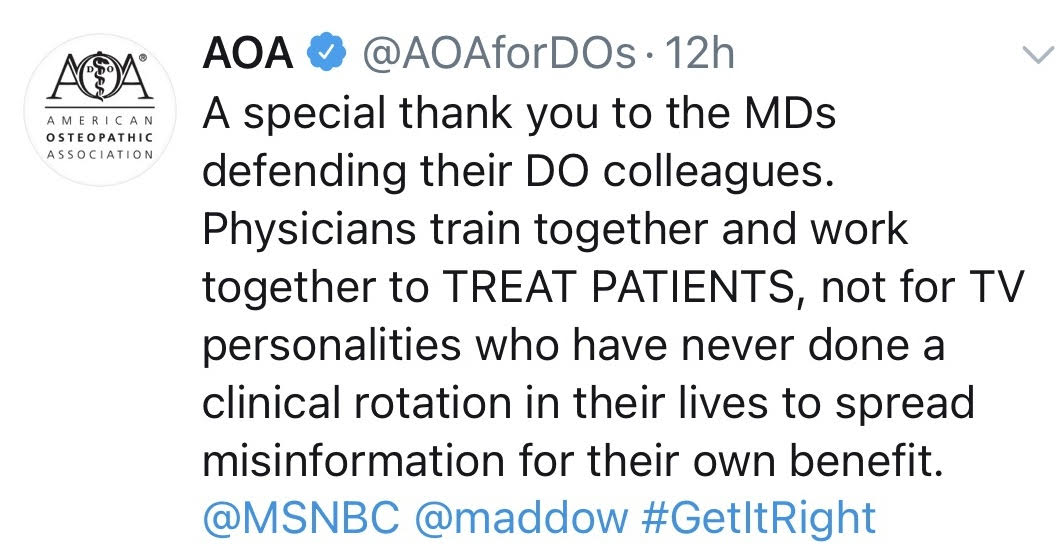
As an osteopathic physician (otherwise known as a DO), we receive the same education as our allopathic or MD counterparts with an additional 250+ hours of training on osteopathic manipulative treatments. Being able to offer an alternative or adjunct treatment to patients gives us a powerful tool right at our fingertips. The following is a list of key differences and similarities between DO and MD degrees:

Osteopathic manipulative medicine (OMM - also known as OMT for Osteopathic Manipulative Treatment) is a set of hands-on techniques used to assess for and treat tissue texture changes, asymmetry, restriction, and tenderness. These techniques include soft tissue and myofascial release (reminiscent of massage therapy) as well as high-velocity low amplitude and articulatory methods. This is similar to a Chiropractor but with a different approach and understanding of the anatomy and musculoskeletal system. We utilize different characteristics and body mechanics to manifest structural changes through positioning, palpating, and balancing planes of motion. These practices can be performed directly into the barrier or indirectly into a position of ease. They can be done actively with the patient contracting their muscles or passively with the muscles relaxed. Learn more HERE.

While residency programs have merged and we train side by side with MDs, the holistic philosophy of our schooling remains ingrained in our approach to patient care. We promote the body’s natural tendencies toward self-healing, self-regulation, and health. We focus on treating the patient as a whole and not just the disease. Below is a list of our four Osteopathic Tenets.

AmorSui's Antimicrobial Gloves
September 22, 2020
 Coming Fall 2020: AmorSui Alice Hamilton Antimicrobial Gloves
Caring for patients extends beyond the hospital and clinic. Recognizing this need as a doctor, commuter, fitness enthusiast, and city dweller, I wanted to offer you all a safe, sustainable, and effective way to decrease your risk of infection. This past year I have been working closely with clothing company AmorSui (Latin for "Self-Love") to turn my idea of antimicrobial gloves into a reality. The Silvadur fabric technology we used is designed to optimize antifungal and antibacterial properties, providing an added layer of protection for your health.
Shop AmorSui and use code DOCTORCOLE for 10% off $100 or more
With a team of empowering women at AmorSui we knew it was only right to name this product after a strong female figure in STEM (Science, Technology, Engineering, and Mathematics). The role model we chose led the crusade against infectious disease as a doctor and researcher. Today of all days marks not only the first day of fall but also the anniversary of her passing, for which we pay tribute to her legacy and introduce the official name for these gloves:
Alice Hamilton




How To Preserve Your Memory
August 26, 2020

A friend of mine recently asked me how I stay motivated to workout, especially during quarantine - how to avoid the "Quarantine 15." As important as exercise is for staying in shape physically, it is just as important for you to stay in shape mentally and not just when it comes to handling stress, anxiety, and/or emotions. Research has found that there is a hormone released during exercise called Irisin, which may have beneficial effects including weight loss, thermoregulation, and neuro-cognitive protection. This includes protecting your memories in hopes of fighting neurodegenerative diseases like Alzheimer's dementia through synaptic plasticity (strengthening the pattern of communication between neurons) and neurogenesis (forming new neurons). Recognizing the impact that fitness has on not just the body but the brain motivates me to stay active and holds me accountable to protect my memories along with all that I have learned (medical school tuition isn't cheap).


While exercise is known to improve cognitive function, especially in neurodegenerative diseases such as Alzheimer's and Parkinson's, understanding how has been and continues to be under investigation. From increasing blood flow to the hippocampus, a part of the brain that helps form new memories, to synaptic plasticity, neurogenesis and decreasing neuro-inflammation, physical activity improves outcomes for the mind as well as the body (Kim & Song, 2018). "The beneficial effects of exercise seem to depend on crosstalk between muscles and nervous tissue through the increased release of muscle irisin during exercise," (Bristot, 2019). This crosstalk plays into memory and is most closely associated with endurance and aerobic routines. "Irisin enhances brain function by modulating neurotransmitter secretion," (Kim & Song, 2018; Mattson, 2012). Because of its brain boosting capabilities, irisin has been purported to be an agent for fighting dementia and memory impairment after being studied in mouse models with Alzheimer's. So, the best way to protect your memory? Well, if you have time to read this blog post, it means you have time to exercise - get out there and get moving!
References:
Bristot, V., et al. "The Role of PGC-1α/UCP2 Signaling in the Beneficial Effects of Physical Exercise on the Brain." Fronteirs in Neuroscience. 2019 March. Retrieved August 26, 2020 from https://www.researchgate.net/publication/332074712_The_Role_of_PGC-1aUCP2_Signaling_in_the_Beneficial_Effects_of_Physical_Exercise_on_the_Brain.
"Irisin: An Overview." ScienceDirect. Retrieved August 26, 2020 from https://www.sciencedirect.com/topics/neuroscience/irisin.
Kim, O. & Song, J. "The Role of Irisin in Alzheimer’s Disease." Journal of Clinical Medicine. 2018 Nov. Retrieved August 26, 2020 from https://www.ncbi.nlm.nih.gov/pmc/articles/PMC6262319/.
Lourenco, M., et al. "Exercise-linked FNDC5/irisin rescues synaptic plasticity and memory defects in Alzheimer’s models. Nature. 2019 Jan. Retrieved August 26, 2020 from https://www.nature.com/articles/s41591-018-0275-.
Mattson M.P. "Energy intake and exercise as determinants of brain health and vulnerability to injury and disease." Cell Metabolism. 2012;16:706–722. doi: 10.1016/j.cmet.2012.08.012. Retrieved August 26, 2020 from https://www.ncbi.nlm.nih.gov/pmc/articles/PMC3518570/.
Why I Chose My Field
August 19, 2020

 |
| Photo credit: @goodforthesoulphoto |
I am not a psychiatrist, I am a physiatrist. I am not a pediatrician, I am a PM&R physician. I am not a physical therapist, I am a Physical Medicine and Rehabilitation doctor.
Despite these common misconceptions, I love the opportunity to teach others about my medical field and why I chose it. As a small yet growing specialty, many people, including medical students, are unfamiliar with who we are and what we do. This is especially true now with limitations placed on shadowing and clinical rotations amidst the COVID19 pandemic. So let me break it down for you:
 |
| Photo credit: @goodforthesoulphoto |
FUNCTION: We optimize a patient’s functionality, enhancing and restoring their abilities to improve their quality of life. As a cheerleader, dancer, runner, and skier, I learned the physics of falling gracefully and using gravity to our advantage. My sports experiences along with my osteopathic medical training gave me a deeper understanding of body mechanics, which helps patients maximize their potential.
SCOPE: We focus on musculoskeletal and neurologic disorders, addressing medical needs both inpatient and outpatient of those with spinal cord injuries, traumatic brain injuries, stroke, amputation, pain, sports medicine, and more. We utilize various diagnostic and treatment modalities like therapy, ultrasound, interventional procedures like epidural steroid injections, botox injections for spasticity and migraines, trigger point injections, and EMGs (electromyography - a study of the health of nerves and muscles).
TEAMWORK: We work closely with physical, occupational, speech, and respiratory therapists as well as case managers, social workers, nurses and other doctors in order to provide a multi-disciplinary treatment approach to patient care.
OPPORTUNITY: The need for more research is in high demand, from regenerative medicine and biotechnology to my own interest in cancer rehabilitation. This past week, an article came out about a group of scientists at Stanford who discovered a way to regrow cartilage in joints in order to "ease movement between bones." This discovery could have promising implications for treating many of our patients who present with joint issues. See below and click here for more information.

PEOPLE: From attendings and colleagues to patients and families there is a breadth of knowledge, mentorship, and education offered. The stories I hear and the progress I observe as patients recover are so inspiring. I have watched as patients who previously could not move are now walking down the hallway to hug their family. Patients who could not talk are now able to tell their children they love them. Just as I motivate my patients to keep fighting, they encourage me to be a better physician.
Learn more about this field at the American Academy of Physiatry's website here.
This post was inspired by fellow physiatrist @doctor.darsh - check him out on Instagram


Social Icons